
Industry Verticals
Pool Deck Sealing and Cleaning for South Florida Condos and Hotels
October 14, 2026 · 10 min read
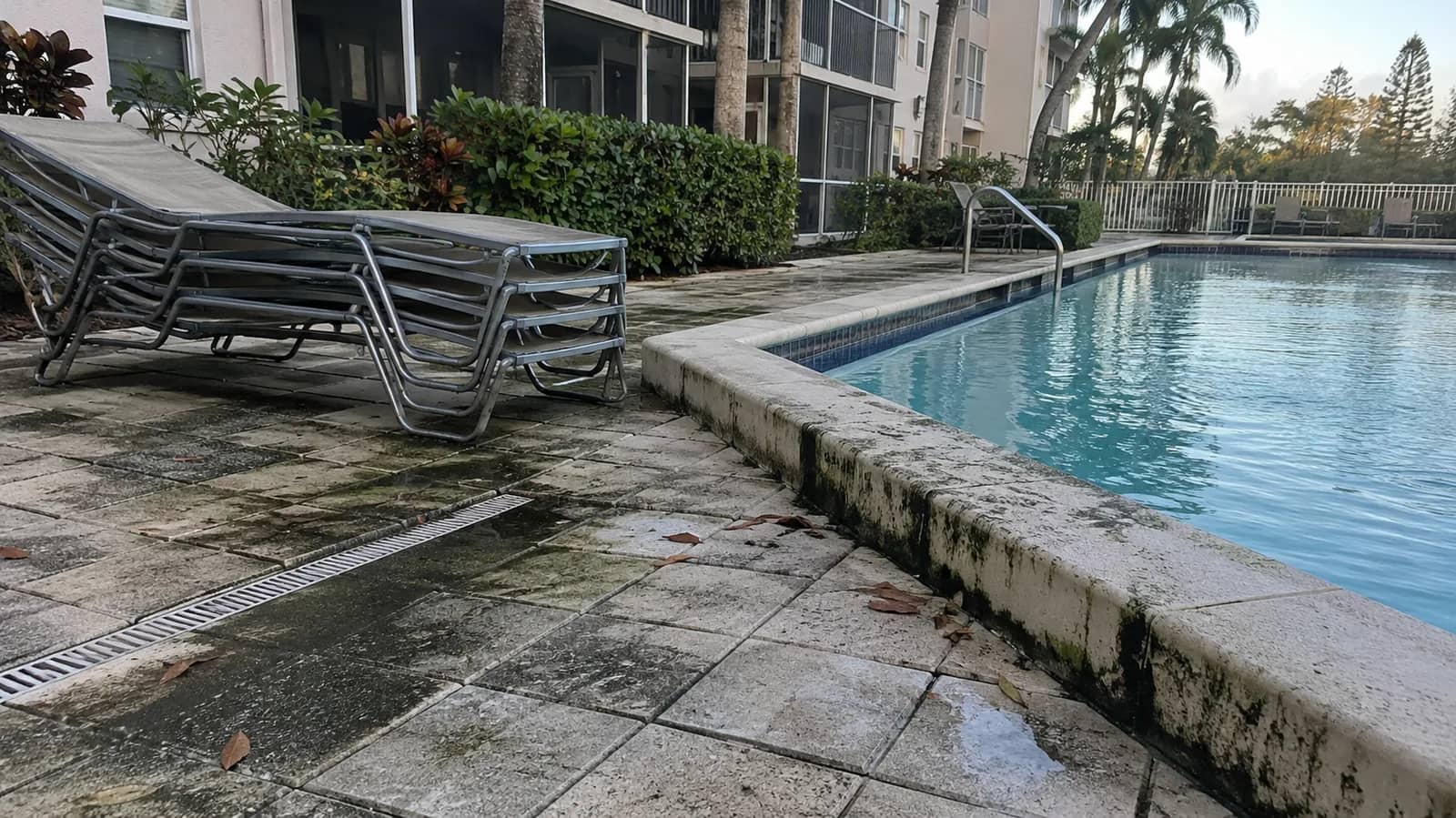
Pool deck sealing works best as the last step in a surface care plan, after the deck is cleaned, damaged areas are assessed and a suitable finish is tested for wet traction. For South Florida condos and hotels, the plan must also account for frequent rain, salt exposure, drainage and the time guests or residents need to regain access.
What pool deck sealing can and cannot do
Pool deck sealing can help protect a sound surface and make routine cleaning easier, but its result depends on the deck beneath it. It cannot repair a failed slope, stabilize moving pavers or turn a slick finish into a safe walking surface without a suitable texture strategy.
A pool deck is rarely one uniform material. A hotel may have concrete pavers at the lounge area, poured concrete at the steps, tile at the waterline and flexible joints where the deck meets the pool structure. Each area needs its own assessment before a product is chosen. A field sealer applied across incompatible surfaces may leave an uneven appearance or create adhesion problems.
The distinction between a surface sealer and a joint sealant matters. A surface sealer covers concrete or pavers. A flexible joint sealant is placed in a designated joint so that movement can occur without opening a path for water. The product sold for pool deck joints is not automatically suitable as a coating for the surrounding deck.
Managers should also identify the actual maintenance goal. If the issue is organic staining and tracked-in soil, cleaning may be the main need. If sound pavers absorb spills readily or their appearance has become uneven, sealing may be worth evaluating. If water ponds or joints are failing, address those conditions before deciding whether to seal.
Clean and inspect before choosing a finish
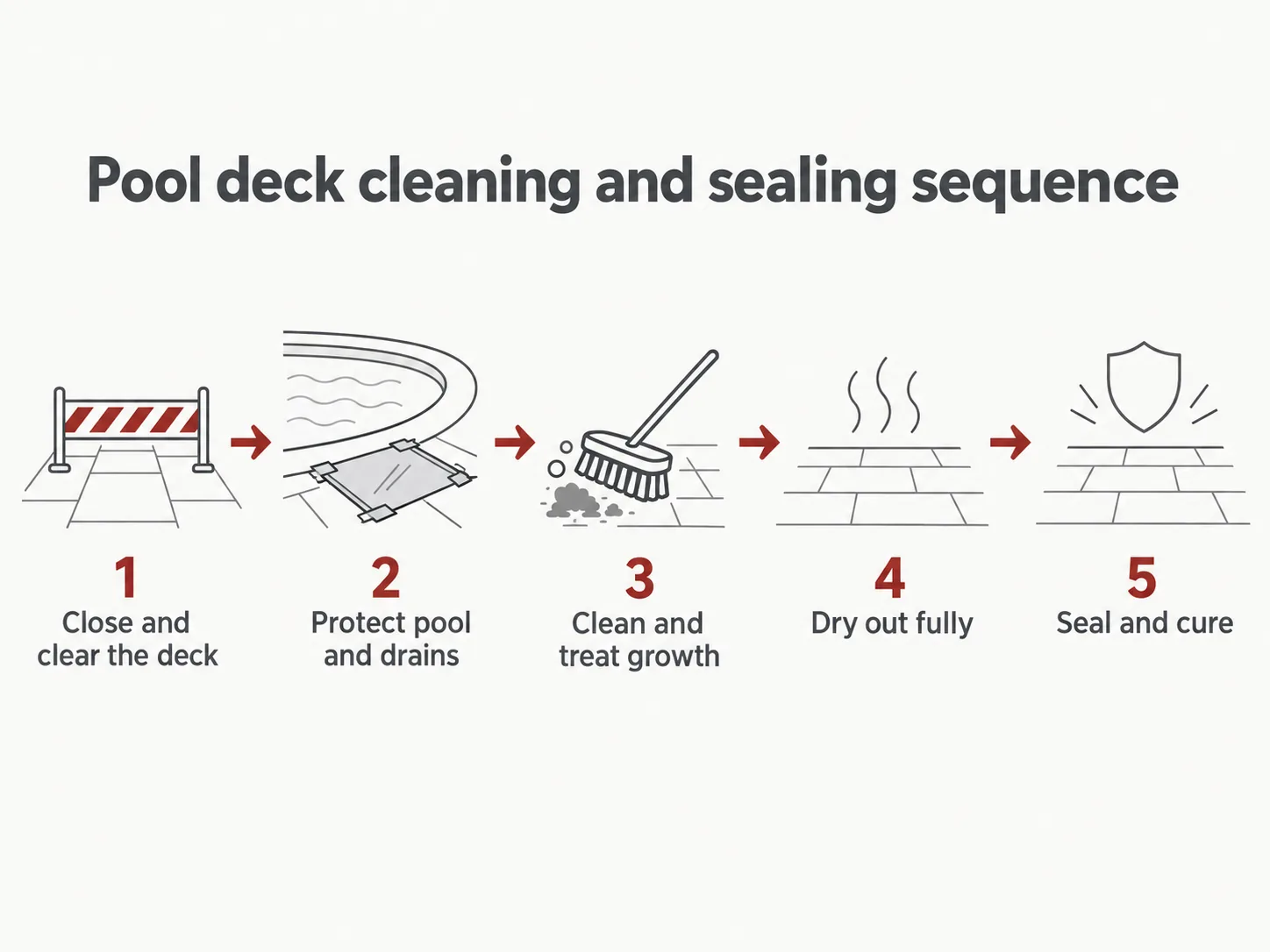
Pool deck cleaning should expose the condition of the surface without damaging it. The sequence is to identify materials and drainage, remove loose debris, treat the soils present, rinse in a controlled direction, then inspect the clean deck before sealing is considered.
Algae staining often concentrates near drains, shaded furniture areas and places where irrigation or splash water keeps the surface damp. Salt air adds residue on coastal properties. Those patterns tell a contractor where to inspect for slow drying and recurring soil, but cleaning alone will not correct a drain that sits high or a low spot that holds water.
Pressure must be matched to the material and its condition. Aggressive washing can remove joint sand from pavers, roughen a finished concrete surface or drive water into vulnerable joints. A gentler chemical treatment with a controlled rinse can be more suitable for organic growth, while localized mechanical cleaning may be needed for stubborn deposits. The trade-off is dwell time and careful rinsing rather than simply increasing pressure.
Before applying a sealer, inspect for loose pavers, open joints, flaking coatings, rust staining and white mineral deposits. Document areas that need repair or further investigation. If moisture is moving up through the deck or a previous coating is failing, a fresh coat can hide the symptom briefly while making the underlying problem harder to diagnose.
For a broader site plan, Miami pressure washing conditions explains why shade, coastal exposure and runoff routes change exterior cleaning work across the property.
Compare surface and sealer options
The right finish depends on the deck material, its present condition and the wet walking experience the property needs. A sample area should be judged after it has dried and after it has been wetted, under the lighting residents or guests will actually encounter.
| Deck condition or goal | Approach to consider | Main trade-off |
|---|---|---|
| Sound concrete pavers with unwanted absorption or staining | Clean, repair joints where needed and test a compatible paver sealer | Some finishes darken the pavers or change wet traction |
| Sound poured concrete with an existing textured finish | Clean and assess whether sealing is needed | A film-forming product may alter the intended texture |
| Decorative concrete with a glossy existing coating | Identify the coating and test compatibility before recoating | More gloss can make wet areas feel slicker |
| Loose pavers, ponding or failed joints | Correct the defect before any coating decision | Sealing must wait for the repair and proper drying |
| Mixed surfaces around drains, coping and expansion joints | Specify each material and joint separately | One product is unlikely to suit every detail |
Penetrating and film-forming products behave differently. A penetrating sealer is intended to soak into a compatible surface with less visible change, but it may offer less of the appearance change a board expects. A film-forming sealer can deepen color or add sheen, yet the resulting surface needs especially careful wet-traction assessment and may show wear patterns in busy routes.
Water-based and solvent-based formulations also differ in appearance, odor and compatibility with earlier treatments. Neither label, by itself, establishes that a product is suitable beside a pool. Ask for the manufacturer's application instructions, confirm what is already on the deck and approve a representative sample before committing to the whole area.
For paver-specific scope, the paver sealing service is the relevant starting point. A proposal should identify cleaning, repairs or exclusions, sealer type, sample approval and how the finished deck will be assessed.
Treat pool deck slip resistance as a finished-surface question
Pool deck slip resistance depends on the material, its texture, contamination, footwear and whether the surface is wet. A sealer that looks appropriate when dry may feel different after splash water, rain or sunscreen reaches the walking path.
The US Access Board's ADA Standards require floor and ground surfaces on accessible routes to be stable, firm and slip resistant. OSHA's walking-surface rule also calls for surfaces to be kept clean and maintained in safe condition where it applies. Neither source gives a universal product choice for a condo or hotel pool deck.
Start with the routes people use: the gate, showers, steps, ramps, restroom approach and the path between seating and the pool. Inspect them wet as well as dry. A textured additive may improve grip in a compatible coating, but it can change appearance and make soil harder to remove. Excessively rough texture can be uncomfortable for bare feet. A sample lets the property weigh those effects before approving the finish.
Do not treat a verbal claim that a sealer is "non-slip" as the end of the review. Ask how the proposed system performs on the property's substrate after application, and how that performance will be maintained as sunscreen, algae and ordinary wear accumulate.
Control wash water and protect the pool
Wash water needs a planned route before pool deck cleaning starts. Block or divert it from the pool where practical, protect sensitive landscaping and identify drains that could carry dirty water to a storm system.
The federal small MS4 permit rule requires regulated storm-sewer operators to prohibit illicit non-stormwater discharges. That makes drain identification and wash-water handling part of the job plan, especially when cleaning lifts algae, sediment or chemical residue. The exact controls depend on the site and the receiving system; a contractor should explain them in the scope rather than assuming every drain leads to the same place.
Pool equipment, furniture bases, metal railings and nearby planting also affect the method. Chemical dwell and rinse directions should account for those surfaces. For a waterfront site, marina and waterfront cleaning considerations offer useful context for salt exposure and runoff planning.
Schedule around South Florida weather and occupancy
South Florida's wet season runs from May to October, so a clear morning does not guarantee a dry deck for the full job. Cleaning, drying, sample review, application and reopening need to follow the selected product's instructions and the actual site conditions.
The Atlantic hurricane season runs from June 1 to November 30, according to the National Hurricane Center. That does not mean deck work must stop for the season. It does mean the manager and contractor need a weather decision point, a plan for securing materials and a practical way to reschedule if rain or a storm interrupts drying or application.
Occupancy can be as limiting as weather. A hotel may need a defined guest route and an alternative access plan; a condo board may need resident notice and a way to keep furniture off treated areas. Break the deck into workable zones only if the transitions can be kept clean and the product can be applied consistently. Otherwise, a larger closure may produce a more uniform result.
Coordinate with pool operations before any work begins. The closure plan should state where water will go, which entrances remain open, who moves furniture, how the treated area is protected and what condition must be met before people return.
Put the scope in terms a board can approve
A useful proposal makes the condition of the deck and the intended result visible to the decision makers. It should distinguish cleaning from sealing, list preparation and repairs separately, and say which stains or defects are unlikely to come out.
| Scope item | What to confirm before approval |
|---|---|
| Surface inventory | Which pavers, concrete areas, joints, drains and adjacent finishes are included? |
| Cleaning method | How will organic growth, salt residue and other soils be treated without harming the surface? |
| Repairs and exclusions | Who handles loose pavers, failed joints, ponding and existing coating failure? |
| Sealer selection | What product is proposed, and what did the wet sample show? |
| Site controls | How will wash water, pool protection, resident or guest access and weather delays be handled? |
| Handover | What must be dry or cured before furniture and foot traffic return? |
For condos, Florida law places maintenance of common elements with the association unless the declaration assigns a limited common element differently. The board should confirm the deck's status in its governing documents rather than assume every poolside feature has the same responsibility. Florida's structural integrity reserve study rules for qualifying condo buildings include waterproofing and exterior painting, but routine deck cleaning or sealing should not be presented as a substitute for a required professional study or structural repair.
HOA and condo managers can place deck work within a wider commercial exterior cleaning plan. Hotels coordinating guest-facing areas may also find the Miami Beach resort cleaning guide useful. For recurring common-area work, commercial and HOA programmes provide the relevant service context.
Frequently asked questions
What happens if I don't seal concrete?
Unsealed concrete can absorb water and staining more readily, depending on its finish and exposure. That does not mean every pool deck needs a coating. A sound, textured concrete deck may be better served by cleaning and repair until there is a clear reason to seal it. The decision should follow an inspection of surface condition, drainage and wet traction.
What is a deck sealant?
The term can mean either a surface sealer or a flexible material installed in a joint. On a pool deck, those are different scopes. A surface sealer treats compatible concrete or pavers, while joint sealant accommodates movement at designated gaps. Ask the contractor to name the product and the exact locations where it will be used.
Can you put epoxy on a pool deck?
Some coating systems may be suitable for an exterior pool deck, but "epoxy" alone does not establish suitability. The existing substrate, sun and water exposure, prior coatings and required wet texture all matter. Review the manufacturer's intended use and test a complete system on the actual deck before approving it for a guest or resident walking area.
How do you keep a sealed pool deck from becoming slippery?
Begin with a surface that is clean, sound and properly drained. Select a compatible finish, test the completed sample when wet and pay particular attention to ramps, steps and high-traffic paths. Afterward, remove algae, sunscreen residue and other buildup as part of routine care. A texture additive may help, but its appearance and bare-foot comfort should be tested.
When should a South Florida pool deck be cleaned and sealed?
Clean when soil and organic growth begin to affect appearance or walking conditions, and inspect the surface before deciding whether sealing is needed. There is no single calendar interval that fits every deck. Shade, salt exposure, irrigation, traffic, drainage and the existing finish change the maintenance need. Plan any sealing window around product instructions, weather and occupancy.
Sources
The guidance above uses the following primary sources for climate, walking-surface requirements, stormwater planning and condominium responsibilities.
For a deck assessment and a scope that separates cleaning and sealing from any repairs that need another trade, discuss the property through 2Clean's paver sealing service.
Custom Commercial & HOA Walkthroughs
Need a scope tailored to your South Florida property?
Every building, plaza, and community has its own surface mix, access windows, and drainage layout. We quote by walkthrough rather than fixed rate sheets so your proposal matches your exact property. Call us directly at (904) 826-9806 or request a written scope online.
Related services & tools
Paver Sealing by South Florida city: