Industry Verticals
Screen Enclosure Cleaning for Condos and HOAs in South Florida
October 15, 2026 · 9 min read
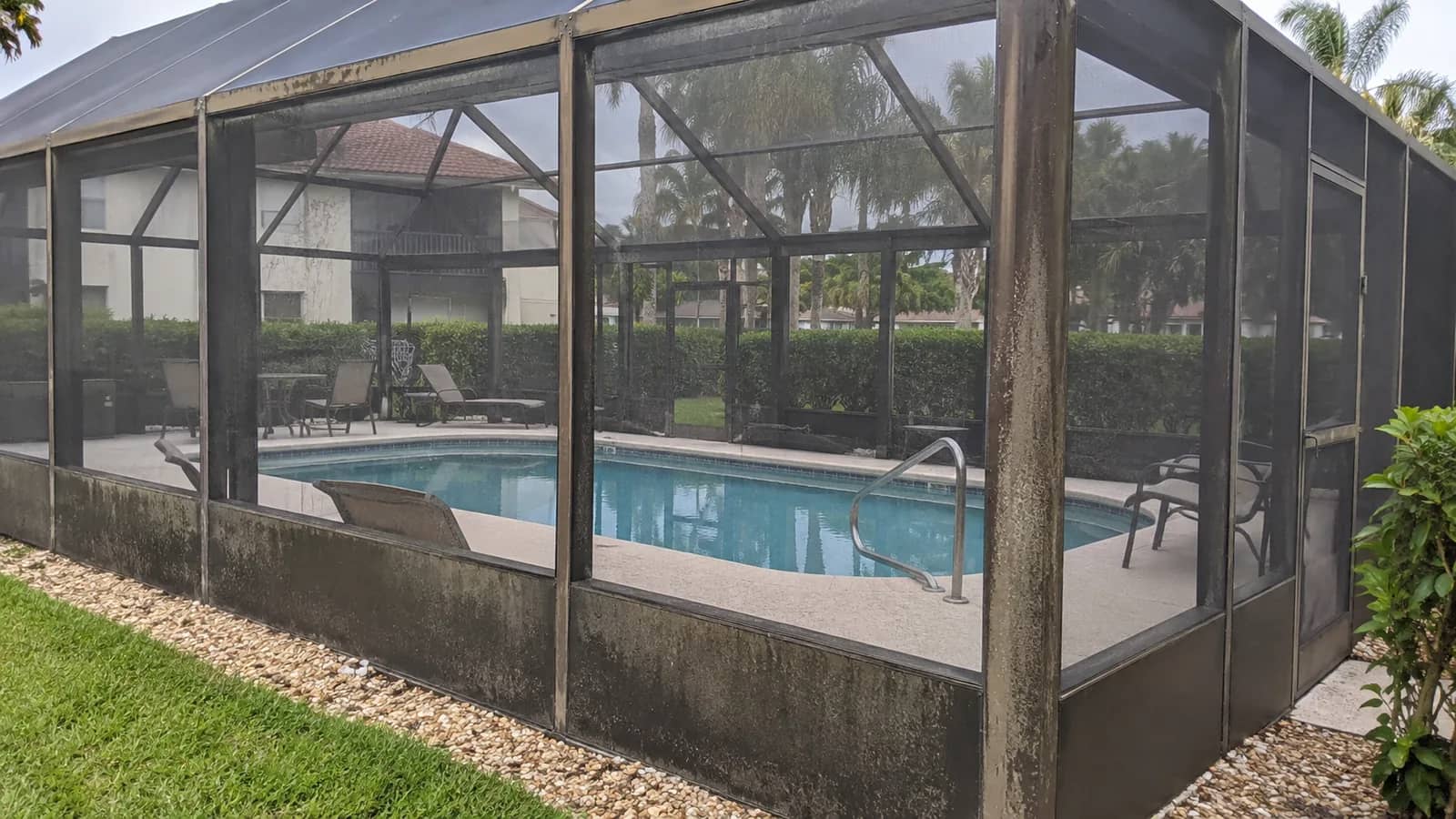
Screen enclosure cleaning for a condo or HOA should remove growth from mesh and frames without forcing water through screens, damaging finishes, or sending wash water into the pool or storm drains. A workable plan starts with material inspection, uses gentle application and controlled rinsing, and gives residents clear notice of pool access changes.
Why screen enclosure cleaning needs a site plan
At a shared pool, the enclosure is only one part of the work area. Residents, furniture, planting beds, deck drains, and pool water all affect how the contractor can clean it safely and where the rinse water can go.
South Florida's wet season runs from May to October, so damp mesh and shaded frame joints can show recurring growth. Salt air can leave deposits on coastal properties. Those conditions make repeat maintenance useful, but they do not justify a fixed cleaning interval for every site. Exposure, tree cover, irrigation overspray, and the condition of the enclosure matter more than a calendar alone.
The board or manager should identify who controls the enclosure, where residents can enter the pool area, and which adjacent surfaces are included. Florida Statutes section 718.113 places maintenance of condominium common elements with the association, except where the declaration assigns a limited common element to an owner. Confirm that allocation before approving work around an enclosure serving a particular unit or shared amenity.
A written scope also helps distinguish routine cleaning from repair. Loose spline, torn mesh, corroded fasteners, failed coatings, and unstable framing need attention beyond washing. Cleaning may make those conditions easier to see; it does not correct them.
Choose the method for the mesh, frame, and soil
Pool screen enclosure cleaning usually calls for a gentle cleaning solution, time to work, and a controlled rinse. Mesh can deform or pull from its spline under a concentrated stream, while aged or chalking frame coatings can shed unevenly when scrubbed aggressively.
A contractor should inspect a representative area before treating the whole cage. Organic growth on mesh calls for a different approach from mineral deposits, salt residue, or oxidation on aluminium. The solution must suit the surface and the surrounding plants and pool equipment, and a small test area can reveal whether a finish is sound enough to clean evenly.
Soft washing describes a lower pressure approach in which the cleaning solution does much of the work. It can reduce the need for force on mesh and coated frames. Its trade-off is that application, dwell time, and rinsing require close control around pool water, landscaping, and occupied areas.
Hand cleaning may be appropriate for a fragile panel, a stubborn frame joint, or a small enclosure. It offers close control but takes more access time and can abrade a weakened coating if the wrong brush is used. Pressure washing has a place on some suitable hard surfaces nearby, but the enclosure itself should not be pressure washed.
| Condition found during inspection | Suitable response | Limit to note in the scope |
|---|---|---|
| Organic growth on sound mesh and frames | Apply a compatible cleaner gently, then rinse with control | Growth may return where shade and moisture persist |
| Loose, brittle, or torn screening | Flag for repair before cleaning that section | Washing will not restore screen tension |
| Chalking or peeling frame finish | Test a small area and use minimal agitation | Cleaning may expose existing coating failure |
| Salt or mineral deposits | Identify the deposit and test the proposed cleaner | A treatment for organic growth may leave deposits behind |
| Rust staining near fasteners | Inspect the source before treating the stain | A stain can return if corrosion continues |
Clean from roof panels down to the deck
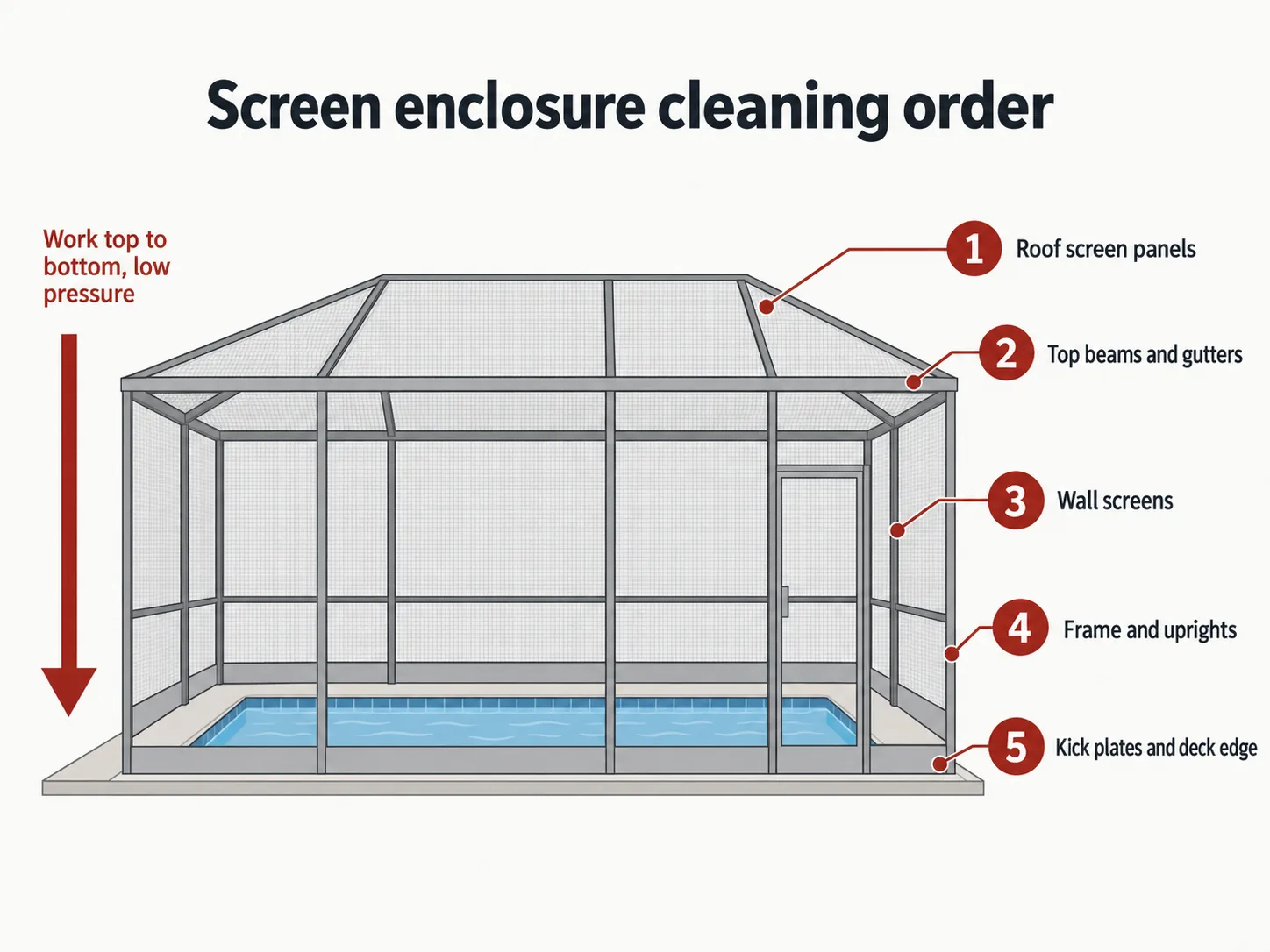
Working from the upper panels downward keeps dirty runoff from crossing areas that have already been cleaned. The crew can then address the frame, wall panels, doors, and kick plates before a final check of the deck edge and nearby fixtures.
The order is simple, but access is often the difficult part. Roof panels and high frame members may require equipment placement on a deck with drains, furniture, planters, or narrow paths. The contractor should establish where equipment can stand without bearing on the screen structure or blocking an occupied exit.
The first inspection should identify damaged mesh, open seams, loose doors, exposed electrical equipment, and surfaces that should stay dry. Pool furniture and movable items can be cleared; fixed fixtures and planting beds need protection suited to the proposed cleaning solution. If adjacent glazing is included, define that work separately so residue is not left on it after the enclosure rinse.
After cleaning, check the enclosure from inside and outside. Look for missed frame joints, cleaner residue, streaks on the kick plates, and debris that collected at the deck perimeter. This final pass is also the time to document defects discovered during cleaning, without presenting them as newly caused damage when their condition is uncertain.
Keep wash water out of the wrong places
Runoff control should be decided before the first panel is wetted. A screened roof can shed solution toward the pool, planting beds, deck drains, and nearby storm inlets, so the contractor needs a route for application and rinsing that fits the site.
The federal municipal stormwater rule requires permittees to effectively prohibit non-stormwater discharges to storm sewer systems and maintain an illicit discharge detection programme (40 CFR 122.34). Florida's Department of Environmental Protection administers its municipal stormwater programme. For the property manager, the practical step is to locate drains and agree on containment and disposal methods appropriate to the site before work begins.
Pool water needs its own protection plan. Avoid spraying solution directly into the pool, and coordinate with the pool operator if cleaning could affect water or equipment. Covering or shielding sensitive items may help, but a cover is not a substitute for careful application. Rinsing should be controlled so loosened growth and residue do not simply move from the screens into the water.
The deck is a separate surface with a separate method decision. If it needs cleaning or sealing, define that work and its access window rather than assuming it is included with the cage. The pool deck cleaning and sealing guide explains the additional surface and scheduling considerations.
Set a maintenance schedule around exposure and storm season
Inspect the enclosure regularly and schedule cleaning when growth or deposits begin to affect its appearance or use. Shaded panels, irrigation-facing walls, and coastal frame joints may need attention sooner than open, well-drained sections of the same property.
For Miami-Dade, Broward, and Palm Beach properties, a useful inspection follows the wet season and checks areas that stay damp. Managers can record recurring trouble spots and adjust future scopes instead of paying to treat every surface the same way. Miami's local cleaning conditions also affect nearby walls and hardscape.
The Atlantic hurricane season runs from June 1 to November 30, according to the National Hurricane Center. Before that period, look for torn screens, loose doors, and visibly deteriorated connections and send repair concerns to the appropriate enclosure professional. Washing cannot establish whether a structure is storm ready, and it should not delay a needed repair assessment.
For a larger property, put the pool cage alongside other exterior work in the commercial exterior cleaning plan. Coordinating access and resident notices can reduce repeated disruption, while each surface still receives a method suited to its material.
Separate enclosure upkeep from association building duties
An enclosure cleaning contract should state what will be cleaned, what will be protected, and which defects will be reported. It should not promise that routine washing satisfies a condominium's structural inspection or reserve study duties.
Current Florida law requires milestone inspections for qualifying condominium and cooperative buildings with three or more habitable stories, generally by the end of the year the building reaches 30 years and every 10 years afterward. A local enforcement agency may set a 25-year inspection based on local conditions. The law does not make proximity to the coast alone an automatic 25-year trigger (Florida Statutes section 553.899).
Qualifying condominium buildings also have structural integrity reserve study requirements under Florida Statutes section 718.112. Required components include the roof, structure, waterproofing and exterior painting, and windows and exterior doors. A pool enclosure cleaning scope is not that study. If washing reveals a concern near a building component, record it and route it to the association's appropriate professional.
HOA obligations depend on their governing documents and applicable law. Florida Statutes section 720.303 addresses HOA budgets and reserves for deferred maintenance, but a manager should still confirm who owns and maintains a particular pool enclosure. Clear responsibility makes it easier to approve repairs separately from recurring cleaning.
What to put in the contractor scope
A useful bid identifies the surfaces, cleaning method, protection measures, runoff plan, and access arrangements. Those details make proposals easier to compare and give the manager a way to check the finished work.
Ask the contractor to distinguish roof mesh, wall mesh, frame members, doors, and kick plates. Record areas excluded because of damage or unsafe access. Specify whether nearby deck, furniture, glass, gutters, and drains are included, protected, or outside the scope.
Resident communication belongs in the plan as well. State when the pool area will be closed, how entrances will be marked, and who confirms that the deck and furniture are ready for use afterward. For a shared amenity, that handoff matters as much as the appearance of the upper panels.
Finally, ask how the crew will report findings. Photos or a concise condition note can separate cleaning issues from torn panels, loose hardware, or coating failure that needs a repair decision. This gives the board a clearer record without asking a cleaning contractor to certify the enclosure's structure.
Frequently asked questions
The right answer depends on the screen's condition, the material beside it, and where rinse water will travel. These are the questions worth settling before a shared pool area is closed for work.
What is the best cleaner for outdoor screens?
Use a cleaner compatible with the screen, its frame finish, and nearby pool and landscape materials. For organic growth, a suitable cleaning solution applied gently can work with less physical force than heavy scrubbing. Test an inconspicuous area first, especially on an older or chalking frame, and follow the product's directions for application and rinsing.
What is the best way to clean a pool deck?
Identify the deck material and what is on it before choosing a method. Loose soil, organic growth, staining, and failed sealer call for different treatment. Protect the pool, manage runoff, and keep residents off the work area until it is ready for use. Deck cleaning should have its own scope, even when scheduled with enclosure work.
How to clean algae off screen enclosure?
Inspect the mesh and frame for damage, then apply a compatible cleaner gently to the affected areas. Allow it to work as directed and rinse without a concentrated stream that could stretch the mesh or dislodge it from the spline. Check shaded joints and lower panels afterward, since those areas can retain residue and show recurring growth.
How to clean window screens without removing them?
First check whether the screen and its mounting are sound. Use a gentle application and controlled rinse that will not drive water through the opening or onto sensitive interior finishes. Clean the surrounding frame and sill as part of the plan, and avoid pushing on loose mesh. A damaged screen may need repair or removal before cleaning.
Can an HOA pressure wash a pool cage?
Pressure washing can damage mesh, loosen spline, and mark an ageing frame finish, so it is unsuitable for the enclosure itself. A contractor may use a different method on a suitable nearby hard surface after checking its condition and controlling runoff. The bid should identify those surfaces separately so "pool cage cleaning" does not imply one method everywhere.
Sources
These sources support the article's statements about association duties, inspections, storm season, and stormwater. Surface and method choices also require an inspection of the particular enclosure.
For a shared pool enclosure in South Florida, 2Clean's commercial and HOA service is a place to discuss the enclosure's condition, access needs, and a cleaning scope that fits the property.
Custom Commercial & HOA Walkthroughs
Need a scope tailored to your South Florida property?
Every building, plaza, and community has its own surface mix, access windows, and drainage layout. We quote by walkthrough rather than fixed rate sheets so your proposal matches your exact property. Call us directly at (904) 826-9806 or request a written scope online.
Related services & tools
Soft Washing by South Florida city: