Methods, Surfaces & Failure Modes
Efflorescence Removal on South Florida Pavers and Concrete
October 18, 2026 · 10 min read
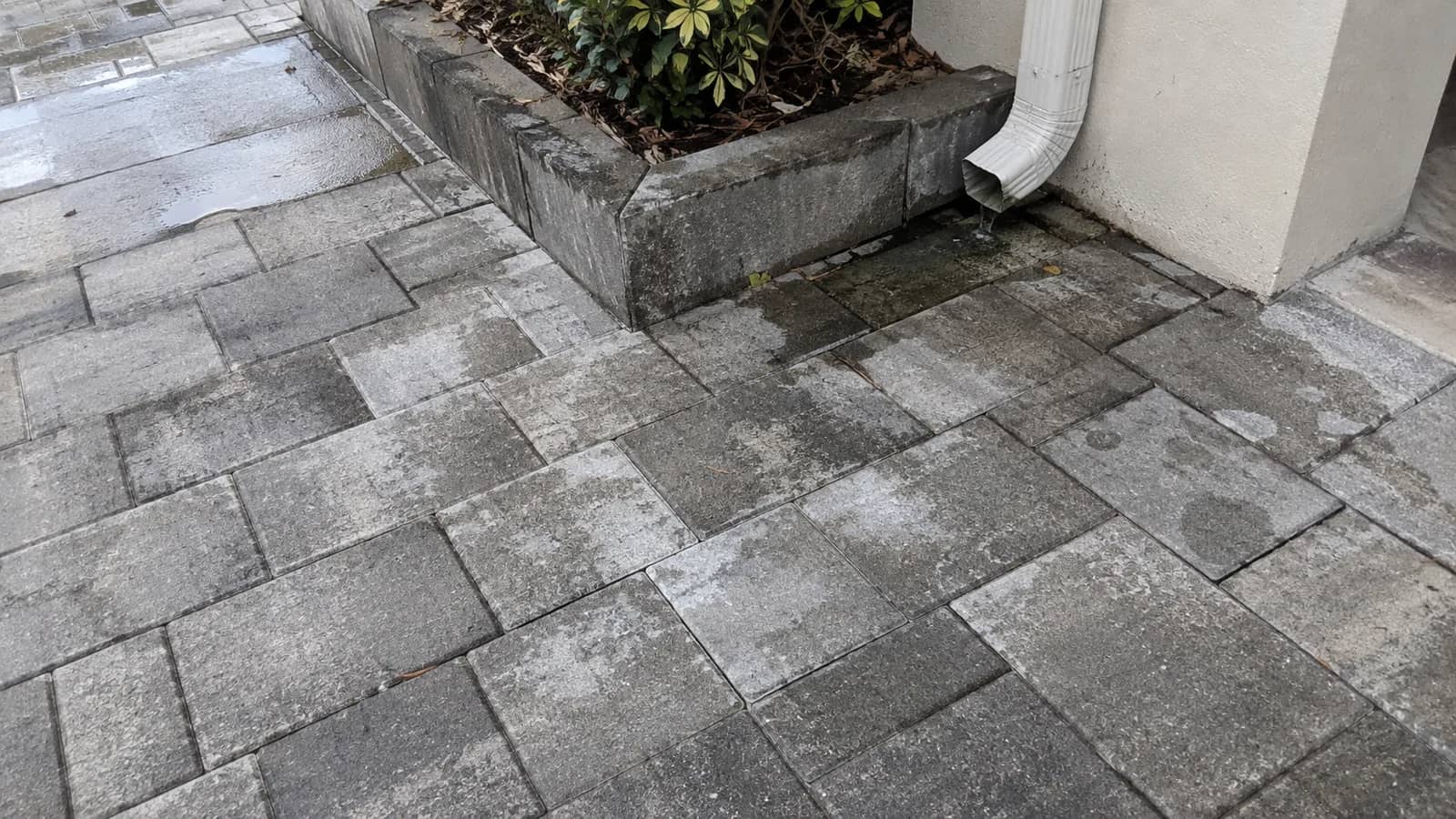
Efflorescence removal starts with identifying the white deposit and the water moving through the surface. Loose salts may brush away, while persistent deposits can need a compatible masonry cleaner and careful rinsing. On South Florida pavers and concrete, cleaning alone may be temporary if drainage, irrigation, or trapped moisture keeps bringing salts to the surface.
Why South Florida pavers develop white deposits
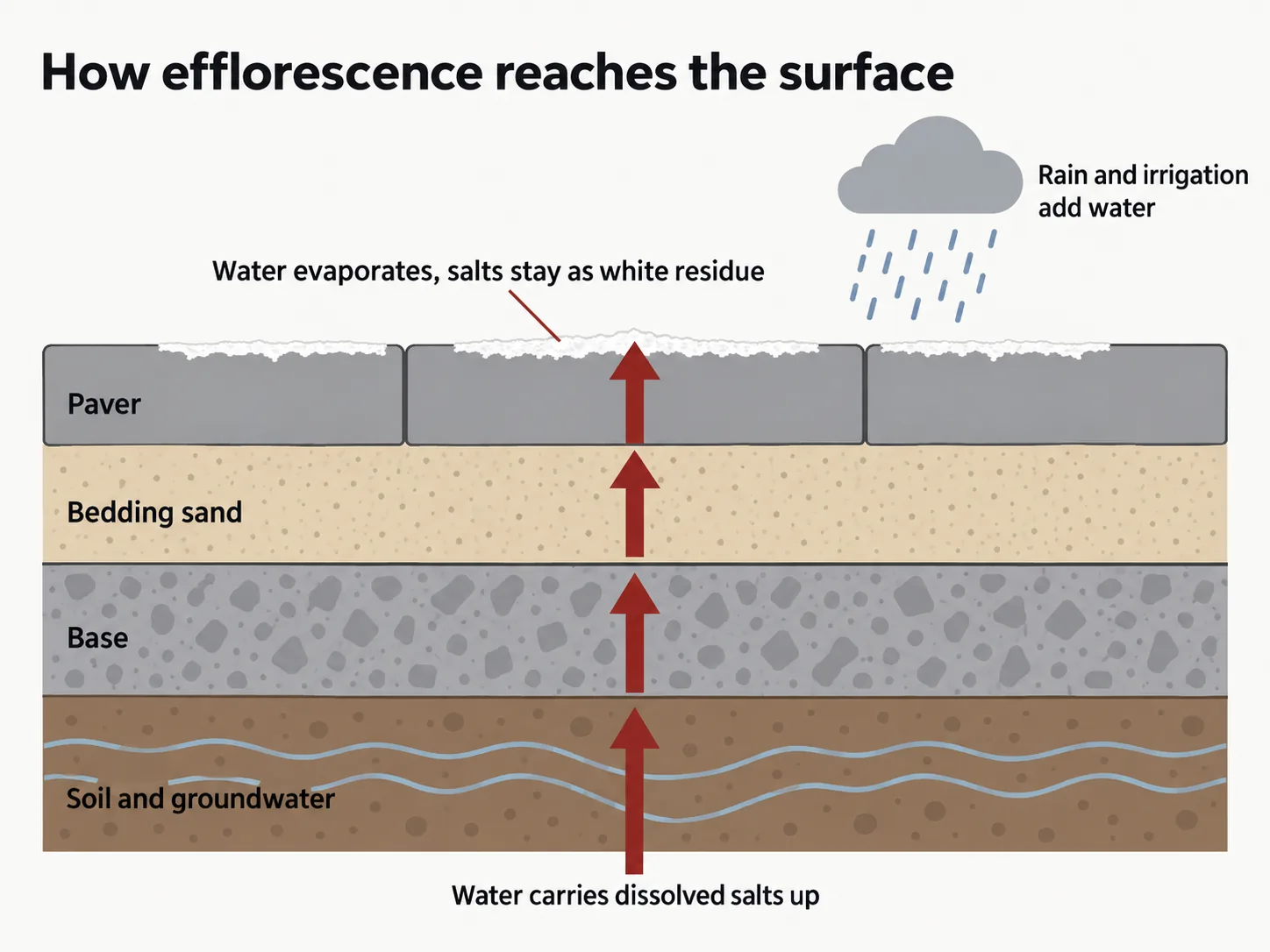
Efflorescence appears when water dissolves salts in concrete, pavers, mortar, or the materials beneath them, then carries those salts to the surface. The water evaporates and leaves a pale, often powdery deposit. Removing that deposit improves appearance, but the water path determines whether it returns.
A commercial walkway can receive moisture from rain above and from damp bedding sand below. Water may also collect where a low spot drains slowly, irrigation repeatedly wets an edge, or runoff crosses the same section of pavement. Fresh concrete and newly installed pavers can show deposits as moisture moves through the materials, even when the installation otherwise looks sound.
South Florida's wet season runs from May to October. That gives exposed paving repeated wetting and drying cycles, especially at entries, courtyards, pool approaches, and uncovered parking areas. NOAA identifies the Atlantic hurricane season as June 1 to November 30, so managers should also consider how heavy rain and storm preparation affect drainage and cleaning schedules.
Salt air is part of the coastal setting, but it does not make every white mark efflorescence. Surface salt left by spray can resemble a mineral deposit, while true efflorescence involves salts moving through a porous material. The distinction matters because washing away salt air residue may solve a surface cleaning problem, while recurring efflorescence calls for investigation below or behind the surface.
Diagnose the white residue before choosing a cleaner
The first decision is whether the white residue on pavers is actually efflorescence. Its appearance, location, and history offer clues, but similar marks can overlap. A small test area is more reliable than treating an entire entrance based on color alone.
| What you see | Possible cause | What to check before treatment |
|---|---|---|
| Dry, powdery white material that brushes off | Efflorescence or surface salt | Look for a recurring moisture path and whether the deposit returns after drying. |
| Hard white crust near irrigation spray or persistent runoff | Mineral buildup | Check water sources and whether the crust sits on top of the material. |
| Cloudy film that appeared after sealing | Sealer haze or trapped moisture | Review when the sealer was applied and whether the haze follows coated areas. |
| Pale patches that seem part of the surface | Wear, color variation, or cleaning damage | Compare protected and exposed areas before using chemicals. |
| White lines concentrated at joints | Salts from joint or bedding materials | Check drainage, joint condition, and where water remains after rain. |
For a manager, timing is useful evidence. A deposit that appeared after a rainy period points toward moisture movement. Haze that appeared soon after sealing deserves a sealer assessment. A mark limited to irrigation overspray may need a water source correction as well as cleaning.
Photograph the dry surface, then note what changes when it is wet. Some deposits become less visible while damp and reappear as the surface dries. That observation helps define the test area, but it does not prove the cause by itself. If the surface has multiple coatings or a history of aggressive cleaning, have the contractor identify those conditions before proposing a chemical treatment.
The distinction also protects the budget. Acidic cleaners intended for mineral deposits can affect concrete color, joint material, nearby metals, and plants if the product or application is unsuitable. A sealer problem may require a different remedy altogether. For other common concrete marks, the cause-led approach in our guide to rust stains on commercial concrete is useful.
How efflorescence removal works
Efflorescence removal usually begins with a dry surface and the least aggressive method that can lift the deposit. A contractor then tests a compatible cleaner if brushing does not produce an acceptable result. The sequence limits unnecessary exposure of the pavers, joints, adjacent finishes, and landscaping.
Start dry when the deposit is loose
Loose crystals can often be lifted with a stiff nylon brush and collected before water is introduced. Dry work is useful because rinsing immediately can dissolve salts and carry them back into porous material or across a larger area. It also shows how much of the white appearance is removable deposit rather than a change in the surface itself.
For a busy commercial entrance, dry brushing may be enough for a light deposit, but it can be labor intensive across a large area. Dust control, pedestrian routing, and protection of nearby doors and storefronts still matter. A contractor should decide where the removed material will go rather than brushing it into planting beds or drains.
Test a cleaner for deposits that remain
A masonry cleaner can help with deposits that have hardened or settled into the texture of concrete. The product must suit the particular paver, concrete finish, joint material, and any existing sealer. A test patch should be judged after the surface has fully dried, when whitening or color change is easier to see.
Some cleaning products are acidic. They can remove a mineral deposit but may also change the appearance of cement-based surfaces or damage sensitive adjacent materials. Stronger chemistry is therefore a trade-off, not an automatic upgrade. The contractor should follow the product directions for surface preparation, application, rinsing, and any required neutralization.
Control rinsing and runoff
Rinsing carries dissolved salts and cleaning residue away from the treated surface. Too little can leave residue behind; uncontrolled rinsing can spread it to adjacent pavement or into a storm drain. The plan should account for where wash water will collect, how it will be contained, and how it will be handled under applicable local requirements.
US EPA rules require municipal storm sewer permittees to run programs that address illicit discharges and effectively prohibit non-stormwater discharges. Florida DEP administers the state's municipal stormwater permit program. Those requirements make runoff planning a practical part of a commercial cleaning scope, particularly where walkway drains connect to a storm sewer.
Use pressure with restraint
Pressure can help rinse durable flatwork, but it is not a substitute for identifying and dissolving a stubborn salt deposit. Excessive force can disturb joint sand, leave visible cleaning lines, or roughen a vulnerable surface. The right pressure and tool depend on the material's condition, not simply on how white it looks.
For a larger site, commercial pressure washing may be part of the work after the deposit and runoff plan are understood. Our guide to pressure washing damage on pavers and other surfaces explains why equipment settings alone do not determine whether cleaning is safe.
Choose the method by surface and site conditions
There is no single treatment that fits every paver and concrete area. The useful choice is the gentlest method likely to remove the identified deposit without creating a new finish, drainage, or access problem. A test section should settle uncertainty before the full area is scheduled.
| Method | Best fit | Main trade-off |
|---|---|---|
| Dry brushing | Fresh, loose powder | Gentle on the surface, but slow on broad areas and ineffective on hard crust. |
| Water rinse | Light, soluble residue on a suitable surface | Simple, but can move salts into joints or surrounding areas if runoff is uncontrolled. |
| Compatible masonry cleaner | Persistent mineral deposits confirmed by testing | More effective on stubborn deposits, with greater risk to color, joints, plants, and adjacent finishes. |
| Pressure-assisted rinse | Durable flatwork needing a controlled final rinse | Efficient across open areas, but excessive force can damage the surface or displace joint sand. |
Concrete pavers often have textured faces and sand-filled joints. Their color and joint condition should be inspected before cleaning, especially where an older sealer may remain. Cast-in-place concrete has no paver joints, but its finish can still be marked by uneven chemical application or an aggressive rinse.
Natural stone near concrete paving needs its own protection. Acidic masonry and efflorescence cleaners etch calcium-based stone such as travertine, coral stone, keystone, marble and limestone, so keep them off that stone entirely and shield it from overspray and runoff. The same caution applies to metal edging, painted walls, glass, and planted borders. On mixed-material properties, the test area should represent each surface the cleaning solution could contact.
Prevent the deposit from returning
Prevention means reducing repeated moisture movement through the paving where the site allows it. Cleaning removes what is visible today; drainage, irrigation, and installation details influence what appears after the next wet period. Some newly placed materials may continue to release salts while they dry, so an immediate permanent result should not be assumed.
Walk the area after rain and look for water that stands, crosses the pavement, or enters from an adjacent bed. Check irrigation heads for repeated overspray and inspect joints or edges where water seems to remain. These observations give a contractor or paving specialist a better starting point than a request to remove all whitening without examining its cause.
Sealer can help protect suitable pavers, but it should not be used to hide active efflorescence. Trapped moisture or residue can leave a cloudy appearance beneath a coating, and sealer performance depends on preparation and product compatibility. Our guide to commercial concrete sealing covers the broader decision; paver sealing should likewise follow cleaning, drying, and a review of the moisture source.
Keep a record of where deposits recur and when they return. A pattern that follows irrigation cycles, wet-season rain, or a particular drain can guide the next repair. Repeated cleaning without that record may make the walkway look better briefly while leaving the underlying cause untouched.
Plan the work around occupants and obligations
For a condo, HOA, hotel, or retail property, the cleaning scope should name the affected surfaces, the likely deposit, the proposed test area, and the runoff plan. It should also explain how people will reach entrances while work and drying are underway. That makes bids easier to compare and gives the board or facilities team a clearer basis for approval.
Florida law assigns maintenance of condominium common elements to the association, except where the declaration assigns a limited common element to an owner. HOA responsibilities depend on the property and its governing documents. For either type of community, a recurring white deposit is useful maintenance information even when the deposit itself is mainly cosmetic.
Walking surfaces also need practical attention during cleaning. OSHA requires covered walking-working surfaces to be maintained in a safe condition, and the ADA Standards call for stable, firm, slip-resistant walking surfaces. A contractor and property team should coordinate access, wet areas, and reopening based on the site rather than treating appearance as the only outcome.
For a broader maintenance plan, see our Miami commercial exterior cleaning guide. It places paving work alongside other exterior surfaces that may need different cleaning methods and schedules.
Frequently asked questions
These questions address common shortcuts and concerns that come up when white deposits appear on commercial paving. The correct treatment still depends on the material, the source of the residue, and a test in a discreet area.
Can vinegar remove efflorescence?
Vinegar may dissolve some light mineral deposits, but it is not a dependable choice for every paver, concrete finish, or adjacent material. Its acidity can affect cement-based surfaces, and a small visible improvement does not address the moisture carrying salts upward. For managed properties, identify the deposit first and test a cleaner approved for the specific surface before treating a large area.
Is efflorescence a serious problem?
Efflorescence is often an appearance issue, but recurring deposits can signal persistent moisture movement. That moisture deserves attention when it accompanies standing water, failing joints, coating problems, or deterioration. A property manager should document where the whitening occurs and whether it returns after cleaning. The deposit alone does not establish that the concrete or pavers are structurally unsound.
How to remove white powder from bricks?
If the powder is confirmed as efflorescence, begin with dry brushing using a suitable nonmetallic brush and collect the loose material. Persistent residue may need a brick-compatible masonry cleaner, tested in a small area and used according to its directions. Check for leaks, drainage issues, or repeated wetting before cleaning, because salts can return while water continues moving through the brick.
Can I use CLR to remove efflorescence?
Do not assume a household mineral remover is suitable for a commercial paver or concrete installation. Product compatibility depends on the surface, finish, joints, sealer, and nearby materials, and the label instructions govern its use. A discreet test and an identified deposit are more useful than choosing a cleaner by brand name. For a broad or high-visibility area, ask for a site-specific cleaning method.
Should pavers be sealed immediately after efflorescence removal?
Sealing should wait until cleaning residue is gone, the pavers are dry, and the cause of recurring moisture has been assessed. A coating applied over remaining salts or damp material can leave a cloudy finish and complicate later correction. The timing depends on the paver, sealer, weather, and site conditions, so the contractor should confirm readiness rather than sealing on a preset calendar date.
Sources
These sources support the climate, condominium maintenance, walking-surface, and stormwater points above. Surface diagnosis and cleaning choices reflect practical trade knowledge that should be checked against the materials at each property.
For a commercial walkway with recurring white deposits, 2Clean can assess the paving before recommending cleaning or paver sealing.
Custom Commercial & HOA Walkthroughs
Need a scope tailored to your South Florida property?
Every building, plaza, and community has its own surface mix, access windows, and drainage layout. We quote by walkthrough rather than fixed rate sheets so your proposal matches your exact property. Call us directly at (904) 826-9806 or request a written scope online.
Related services & tools
Paver Sealing by South Florida city: