
Methods, Surfaces & Failure Modes
Tile Roof Cleaning in South Florida: Why Tiles Crack and What a Safe Clean Looks Like
October 19, 2026 · 8 min read
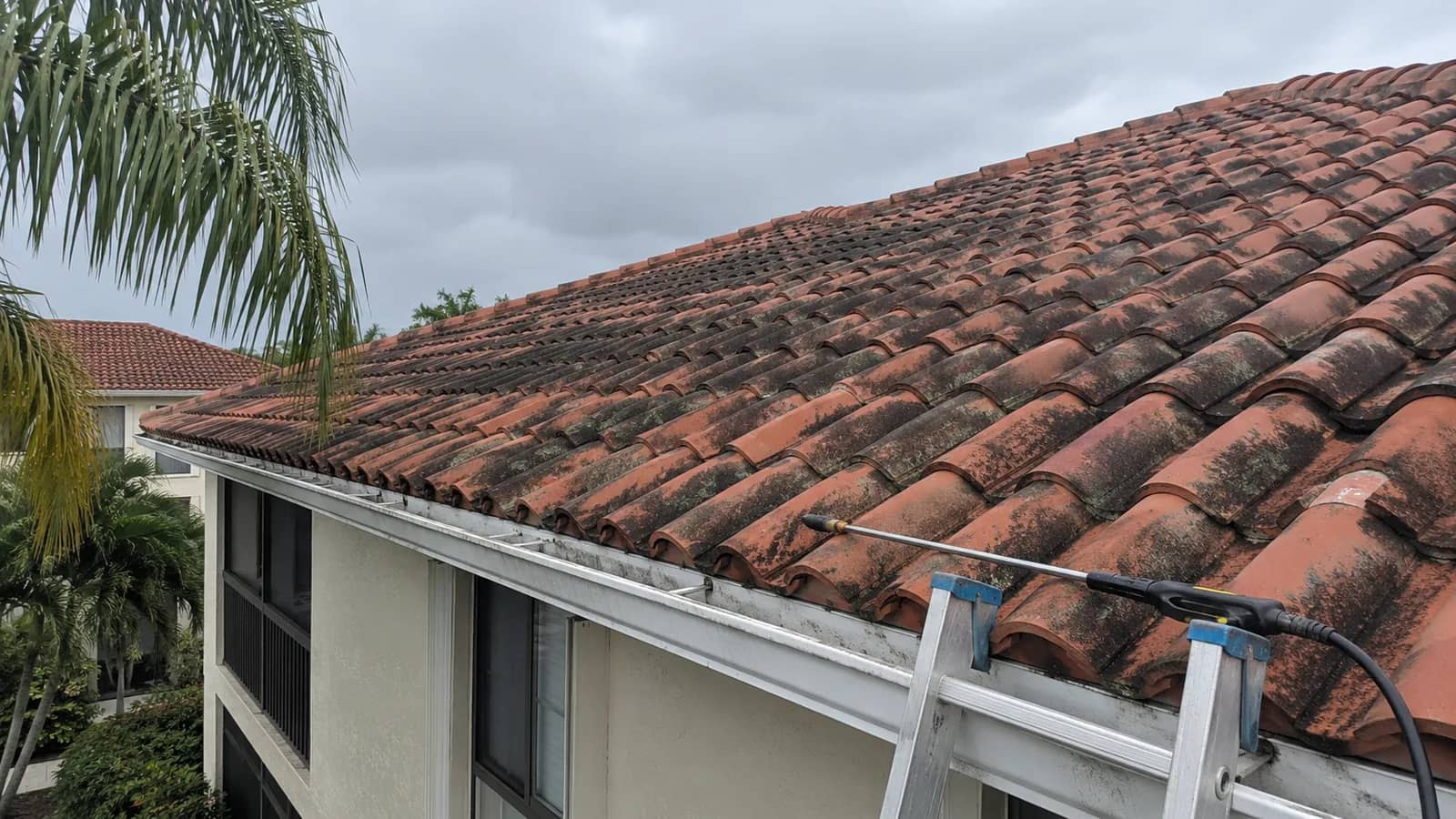
Tile roof cleaning can crack tiles when workers walk on unsupported edges, drag equipment across the roof, or use a forceful spray on vulnerable areas. A safer clean starts with a roof inspection, limits foot traffic, uses a low-pressure treatment suited to the tile, and protects drains, landscaping, and people below.
Why roof tiles crack during cleaning
Most cleaning-related cracks come from concentrated loads on a vulnerable tile, not from the appearance of the cleaning solution alone. A roof can also have cracked tiles before anyone arrives, so a pre-clean inspection matters when the board or property manager needs to understand what changed.
Clay barrel tiles and concrete tiles are durable roof coverings, but each tile has a shape, support pattern, and condition that affect how it carries weight. Stepping on an edge or an unsupported section can put force where the tile is least able to take it. A weathered tile may already have a hairline crack that becomes visible when someone walks nearby.
Equipment adds another source of load. A hose pulled across ridges, a ladder resting against an exposed edge, or repeated trips over the same route can disturb tiles even when the spray pressure is low. The access plan therefore deserves as much attention as the wash method.
High-pressure spray creates a separate risk. It can drive water into laps and openings, dislodge loose material, and place unnecessary force on aging surfaces. That does not mean every tile roof fails under professional pressure washing. The Tile Roofing Industry Alliance says professional low-intensity pressure washing can be used on clay and concrete tile if cleaning is desired. For a property with unknown repairs, fragile tiles, or sensitive areas beneath the roof, a lower-pressure approach gives the crew more control.
Tile roof cleaning: pressure and soft wash compared
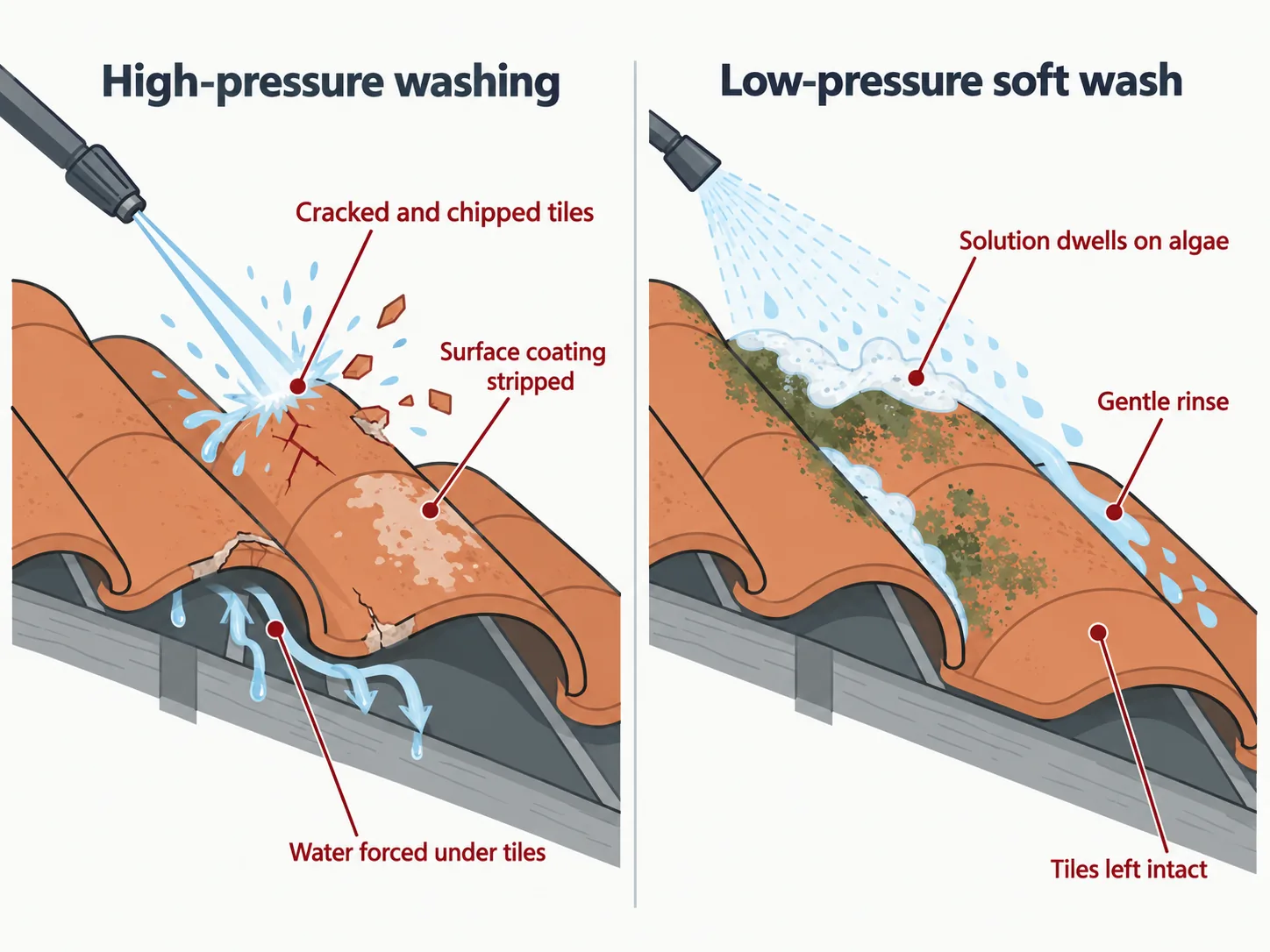
A soft wash tile roof treatment relies on an appropriate cleaning solution and low-pressure application to address biological staining. Pressure-based cleaning relies more heavily on spray force, so the contractor must judge whether the tile condition, roof details, and water entry risks make that force acceptable.
| Consideration | Low-pressure soft washing | Pressure-based tile cleaning |
|---|---|---|
| What removes the staining | A cleaning solution does most of the work, followed by a controlled rinse or weathering plan suited to the treatment | Spray force removes surface buildup |
| Main roof concern | Chemical compatibility, dwell time, overspray, and runoff | Water intrusion, disturbed tiles, and force on weakened areas |
| Access concern | Workers and hoses can still crack tiles | Workers, hoses, and equipment can still crack tiles |
| Best discussion before work | Where solution and rinse water will go, and what surfaces need protection | Whether tile condition and roof details can tolerate the proposed intensity |
Neither column replaces a site inspection. Moss, algae, dirt, loose debris, and staining do not all respond the same way, and an aggressive attempt to make every tile look uniform can create damage without improving roof performance. Ask the contractor to describe the treatment, the access route, and any staining that may remain.
The method changes again on asphalt. The Asphalt Roofing Manufacturers Association advises against a power washer or brush for algae discoloration on asphalt roofing because high-pressure washing is likely to damage it. A proposal covering both tile and shingle roofs should identify the surfaces separately; shingle roof cleaning should not inherit a tile-cleaning method by default.
What a safe commercial roof clean includes
A safe clean is a managed sequence, from inspection through final documentation. For a hotel, retail property, condo, or HOA, that sequence must also account for entrances, parked vehicles, planted areas, and the people using the site during the work.
Before cleaning, the crew should identify visibly broken or displaced tiles, patched areas, roof penetrations, gutters, drains, and places where water could reach occupied space. Photographs establish the starting condition. They also let the manager decide whether a roofer should address a defect before cleaning continues.
The work plan should then explain how people and equipment will reach each section. Limiting roof traffic can reduce tile loads, but it does not remove them wherever roof access is necessary. If the plan depends on walking the roof, ask how the crew will avoid unsupported tile edges and protect vulnerable transitions.
Protection below the roof is part of the method. A low-pressure application can still drift onto windows, metal, landscaping, and pedestrian areas. The contractor should explain how those areas will be isolated, monitored, and rinsed as appropriate, and how runoff will be kept out of places it should not enter. Federal MS4 rules require permittees to address illicit discharges to storm sewers; Florida DEP administers the state's municipal stormwater programme. A site-specific water plan is more useful than a general promise to be careful.
Finally, agree on what completion means. Biological staining may lighten as treatment works, while mineral marks or permanent discoloration may remain. The final walkthrough should distinguish cleaning results from tile damage and identify any area that needs a roofer's assessment.
South Florida timing and property responsibilities
In South Florida, cleaning plans have to fit rain, storms, salt exposure, and occupied properties. Timing alone will not prevent algae from returning or protect a roof in a storm, but it can make access and runoff easier to manage.
The wet season runs from May to October, when frequent rain can interrupt application and complicate control of rinse water. Salt air near the coast can leave residue on exposed surfaces and add to the maintenance burden around roof edges and metal details. The Atlantic hurricane season runs from June 1 to November 30, according to the National Hurricane Center. A cleaning visit can reveal a displaced tile or blocked drain, but cleaning is not a substitute for roof inspection or repair.
For condos, responsibility begins with the governing documents and the roof's status as a common element. Florida Statutes section 718.113 assigns maintenance of common elements to the association, with an exception for limited common elements assigned to owners by the declaration. HOA obligations likewise depend on the property's documents and circumstances. Managers handling notices can use the separate guide to Florida HOA roof and driveway cleaning requirements.
A board should keep the cleaning scope distinct from roofing work. If the initial inspection finds a leak, loose tile, or failing repair, record it and determine who will assess it before washing nearby. That protects the building and gives owners a clear account of what the cleaning contractor was asked to do.
How to assess a tile roof cleaning proposal
A useful proposal makes the method and its limits reviewable. It should say which roof surfaces are included, how the contractor will reach them, what treatment is proposed, what will be protected, and how existing damage will be recorded.
Use this checklist when comparing scopes:
| Ask the contractor | What a useful answer covers |
|---|---|
| What condition did you observe? | Visible cracked or loose tiles, repairs, staining, drainage issues, and areas needing a roofer |
| Where will workers and hoses go? | Access points, walking routes, equipment placement, and protection at vulnerable edges |
| How will each roof surface be cleaned? | A separate method for clay tile, concrete tile, and any asphalt shingle sections |
| How will the site be protected? | Entrances, vehicles, plants, windows, adjacent finishes, and runoff paths |
| What result should we expect? | Staining likely to improve, marks likely to remain, and what the final walkthrough will document |
A proposal that says only "pressure wash roof" leaves the most consequential choices unresolved. A proposal that says only "soft wash" can leave the same gaps. The manager needs enough detail to understand the actual roof, treatment, access, and protection plan.
For a broader view of roof surfaces and site coordination, see the commercial roof cleaning guide. If black streaks are the main concern, the guide to roof staining and Gloeocapsa magma explains what cleaning can address. These discussions can help frame a scope, but the roof's present condition should decide the work.
Frequently asked questions
Can I jet wash my roof tiles?
Clay and concrete tile can sometimes be cleaned with professional low-intensity pressure washing, as the Tile Roofing Industry Alliance notes. That is different from assuming a strong jet is suitable for every roof. Tile condition, openings, repairs, access, and water entry risk all matter. For an occupied South Florida property, ask for the proposed intensity and protection plan before approving the method. 2Clean does not pressure wash roofs; its roof cleaning is a low-pressure soft wash. 2Clean does not pressure wash roofs; its roof cleaning is a low-pressure soft wash.
What is the 25 rule in roofing?
"25 rule" is too vague to use as a cleaning or repair decision. The person using it may mean a rule about roof damage, replacement, or local permitting, and the applicable requirements depend on the specific work and jurisdiction. Ask them to identify the rule in writing and have a qualified roofing professional assess damage. Cleaning should not be treated as a shortcut around a needed repair decision.
Does soft washing prevent roof tiles from cracking?
No. Low-pressure application reduces the force of the spray, but workers, ladders, hoses, and equipment can still load or strike tiles. Existing cracks can also become visible during the job. The practical safeguards are a documented starting condition, a deliberate access route, limited traffic, and a clear process for stopping work if a vulnerable area is found.
Is tile cleaning the same as shingle roof cleaning?
No. Clay and concrete tiles have breakage and water-entry concerns tied to their shape, support, and condition. Asphalt shingles have a different surface that can be damaged by brushing or high-pressure washing. ARMA recommends a sodium hypochlorite treatment with a gentle rinse for algae discoloration on asphalt roofing and says the result is temporary. A mixed-roof property needs a method for each surface.
How often should a commercial tile roof be cleaned?
There is no useful fixed interval for every South Florida roof. Exposure, tree cover, drainage, visible staining, tile condition, and the property's appearance requirements vary. Inspect the roof and its drainage regularly through the property's maintenance programme, then schedule cleaning when the condition warrants it. If tiles are loose or leaking, arrange a roofing assessment before the cleaning visit.
Sources
For a site-specific scope, ask 2Clean about roof cleaning for your property and share any known tile damage or access constraints before the visit.
Custom Commercial & HOA Walkthroughs
Need a scope tailored to your South Florida property?
Every building, plaza, and community has its own surface mix, access windows, and drainage layout. We quote by walkthrough rather than fixed rate sheets so your proposal matches your exact property. Call us directly at (904) 826-9806 or request a written scope online.
Related services & tools
Roof Cleaning by South Florida city: