Procurement & Vendor Selection
Certificate of Insurance for Contractors: A Florida Property Manager's Checklist
October 14, 2026 (updated) · 12 min read
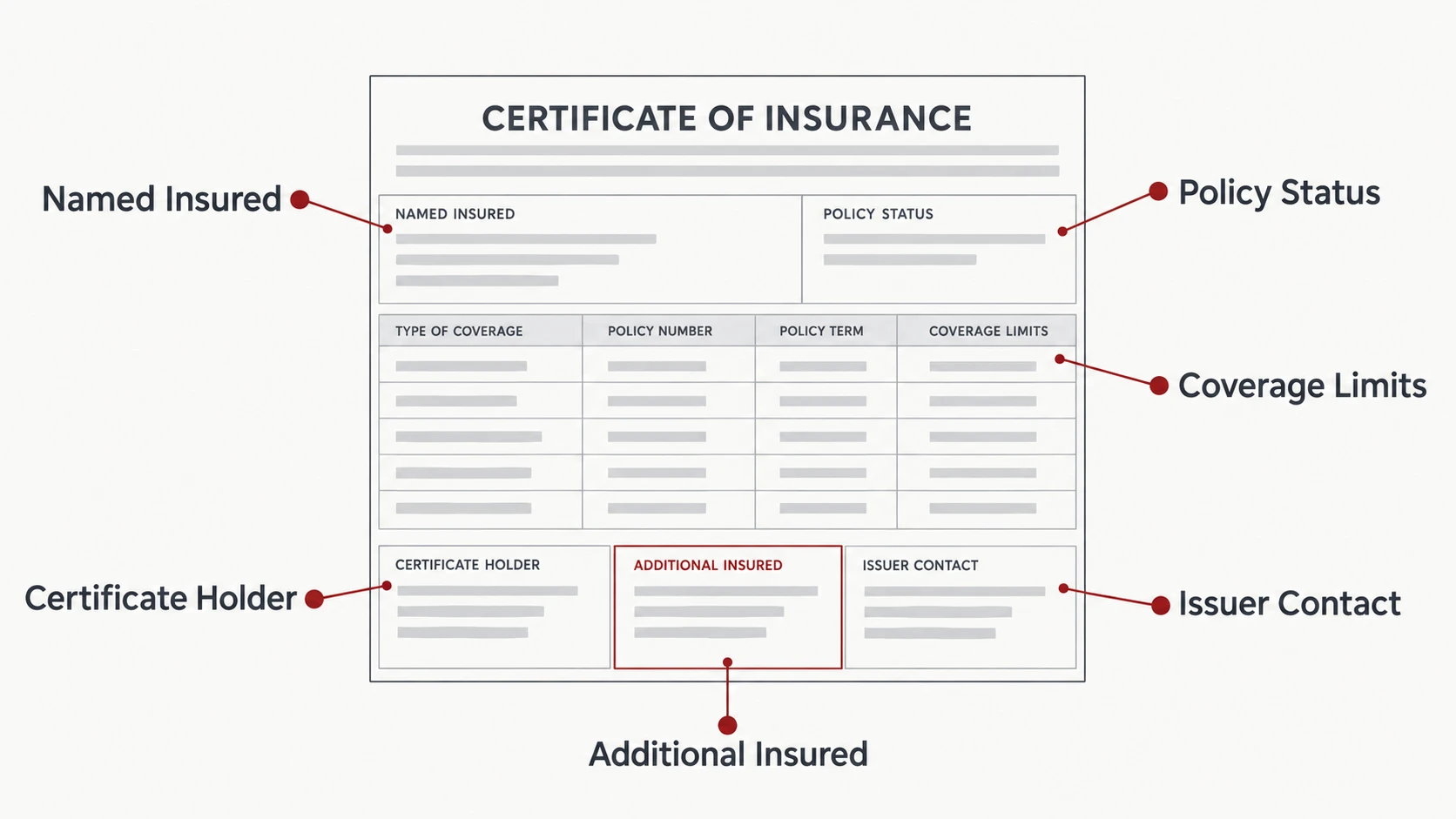
A certificate of insurance for contractors summarizes the policies a contractor reports carrying, including coverage types, limits, and policy dates. Before exterior work begins, match the certificate to the contractor and job, request any required additional insured endorsements, and confirm the coverage with the issuing insurance producer. The certificate alone does not grant coverage.
What a certificate of insurance for contractors tells you
A certificate of insurance, or COI, gives you a snapshot of reported insurance at the time it is issued. It helps a South Florida board or facilities team screen a vendor, but the underlying policies and endorsements determine what coverage actually applies to a claim.
On a typical contractor certificate, check the named insured, insurers, insurance producer, policy numbers, coverage types, limits, effective dates, expiration dates, and certificate holder. The named insured should match the business named in your proposal and contract. If a different company will perform the work, ask how that company is insured rather than assuming the certificate covers it.
The certificate holder field tells the producer where to send the document. It does not, by itself, make the association, owner, or management company an additional insured. Likewise, wording typed in a description field cannot replace an endorsement required by your contract.
This distinction matters when bids look similar. A contractor may send a complete-looking PDF while a requested endorsement is missing, a policy expires during the project, or the listed business differs from the contracting entity. Use the COI to identify what to confirm, then keep the confirmation with your procurement records.
COI checklist by property type
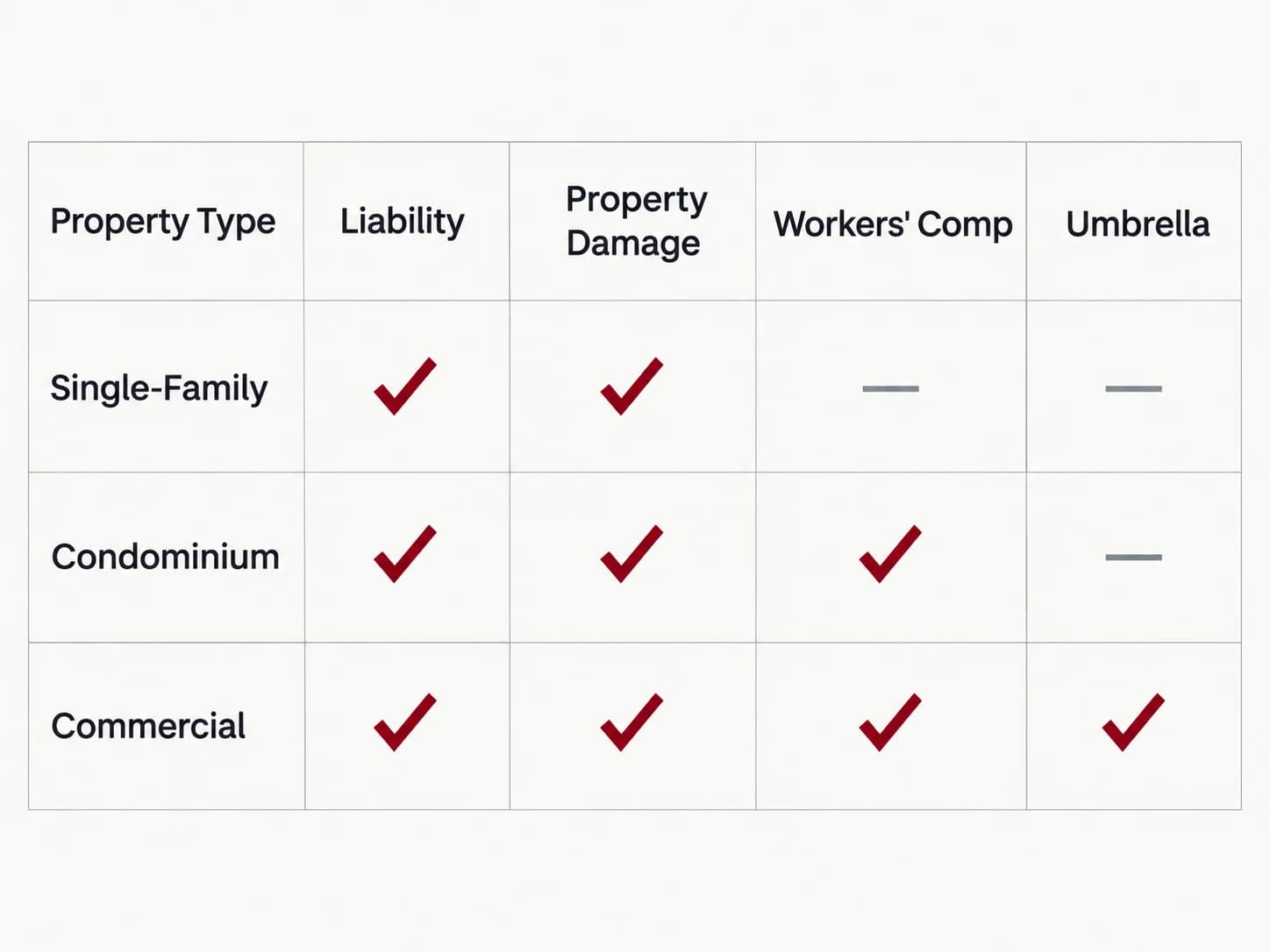
Start with the tasks, access conditions, and people exposed to the work, then set insurance requirements for that job. A low-access sidewalk cleaning assignment and a project beside occupied entrances, parked vehicles, or sensitive finishes may call for different review, even at the same property.
| Property or work setting | Risks to describe in the request | Documents and coverage to discuss with your adviser |
|---|---|---|
| Condominium or HOA common areas | Residents, vehicles, landscaping, shared walkways, and building finishes | General liability, workers' compensation documentation, commercial auto where vehicles are used, and any required additional insured endorsement |
| Hotel or retail exterior | Guests or shoppers moving through work areas, entrances, signs, glass, and adjacent businesses | General liability, workers' compensation documentation, commercial auto where applicable, and review of limits and exclusions against the access plan |
| Roof or elevated exterior work | Falls, falling materials, nearby property, and work performed by subcontractors | Coverage for the actual activity, workers' compensation documentation, subcontractor documents, and endorsements required by the contract |
| Paver sealing or chemical-intensive work | Product handling, overspray, drainage, and nearby surfaces | Coverage for the stated operations, review of relevant exclusions, and a separate plan for material handling and wash water |
This is a procurement checklist, not a statement of Florida's legal minimums. Ask your insurance adviser and counsel to set limits and contract language for the exposure. A fixed limit copied from another property can be too low for one project or poorly suited to another.
For condominium common elements, Florida Statutes section 718.113 generally assigns maintenance responsibility to the association, subject to the declaration's treatment of limited common elements. That makes a documented vendor review useful, but the statute does not supply a universal COI checklist for exterior cleaning.
Insurance review also belongs beside the work plan. For pressure washing, ask where water and residue will go. Federal MS4 permit rules require regulated storm sewer operators to address illicit discharges and effectively prohibit non-stormwater discharges through an ordinance or other mechanism. A COI does not answer whether the contractor's wash water plan meets the rules that apply at your site.
Set contractor insurance requirements before bids
Write the insurance requirements into the request for proposals and contract before selecting a vendor. Contractors can then price and plan the same scope, while your board or facilities team can compare documents against an agreed standard.
Describe the work plainly: surfaces, methods, access equipment, chemicals, vehicle use, subcontracting, and whether areas remain open to residents or customers. Pair that description with a written exterior cleaning scope. The scope helps your adviser assess coverage for the work the contractor will actually perform, rather than for a vague label such as "exterior services."
Ask the adviser to identify the coverage types and limits to require. General liability addresses certain third-party injury and property damage claims, subject to policy terms. Workers' compensation concerns work-related employee injuries. Commercial auto concerns covered vehicle exposures. Additional coverage may be appropriate for particular operations, but a line on a certificate does not establish that every activity or loss is covered.
Specify the exact legal entities that need to appear as certificate holders and, where the contract requires it, additional insureds. An association, property owner, and management company may be separate entities. Confirm their names with the contract documents rather than using "the board" as a substitute for a legal name.
Finally, state when documents are due, who reviews them, and how replacements are supplied when policies renew. Put those duties in the commercial pressure washing contract so the paperwork process continues after the bid is accepted.
Read the COI against the contract and scope
Review the certificate line by line against your written requirements. The most useful question is not simply whether every box contains text, but whether the document identifies the right contractor, covers the right period, and points to policies and endorsements that address the contracted work.
Check the named insured first. Compare it with the proposal, contract, invoice name, and any business name used by the crew. A trade name may differ from a legal entity, so ask the producer or contractor to explain a mismatch instead of rejecting or accepting it by guesswork.
Next, review each relevant coverage line. Note the insurer, policy number, limits, and dates. A policy that expires before scheduled completion needs a renewal plan; a policy that began after the proposed start date needs clarification. Read the general liability entries with your adviser if the aggregate, per-occurrence, or other limits are unclear.
Look at the certificate holder's name and address, then review any description of operations. The description can help identify the project or requested parties, but it is not a substitute for policy wording. If your contract calls for additional insured status or a waiver of subrogation, request the applicable endorsement and have your adviser compare it with the contract.
A clean COI also does not resolve every exclusion. Ask specific questions about work that could change the risk, such as roof access, sealing products, work near glass, or operations performed by a subcontractor. The answer may require an endorsement, a policy review, a revised work method, or a change to the contract.
Additional insured status and waivers of subrogation
If your contract requires additional insured status, ask for the endorsement that applies to the named entity and the contractor's operations. Being named only as a certificate holder does not provide that status, and additional insured coverage remains subject to the endorsement and policy terms.
Use the association's or owner's exact legal name. If the management company also needs protection, say so in the contract and request documentation for that entity too. Your adviser can determine whether the endorsement covers ongoing work, completed work, or both as the project requires.
Additional insured status and contractual indemnity serve different purposes. An indemnity clause sets obligations between contracting parties; an insurance endorsement defines rights under a policy. One should not be treated as proof of the other. Review both with the people responsible for your insurance and contract terms.
A waiver of subrogation is another separate request. In general, it limits an insurer's ability to seek recovery from a specified party after paying a covered loss, to the extent the policy and endorsement provide. It does not erase every claim between the parties or automatically follow from additional insured status. If your contract requires a waiver, request evidence of the applicable endorsement rather than relying on a notation on the COI.
Workers' compensation, exemptions, and subcontractors
Ask how everyone performing the work is covered, including crews supplied through another business. A contractor's statement that an owner is exempt does not tell you how employees or subcontractors working at the property are insured.
Florida workers' compensation obligations depend on the business and work involved. Avoid applying a casual rule of thumb to every exterior contractor. If someone claims an exemption, ask for the supporting documentation and have your insurance adviser or counsel assess it against the proposed staffing and scope. The decision should be recorded before work starts.
Request insurance documents for each subcontractor that will perform a material part of the job. Compare the subcontractor's legal name and work with the main contractor's plan. If the subcontractor changes, require updated documents before that company begins. The prime contractor's COI alone may not establish coverage for a separate firm's operations.
This review is especially useful when a proposal combines cleaning, roof work, window cleaning, or sealing. Ask who performs each task and whether the proposed methods change after award. The guide to comparing commercial cleaning proposals can help identify scope gaps before you finalize the insurance request.
Verify the certificate before work starts
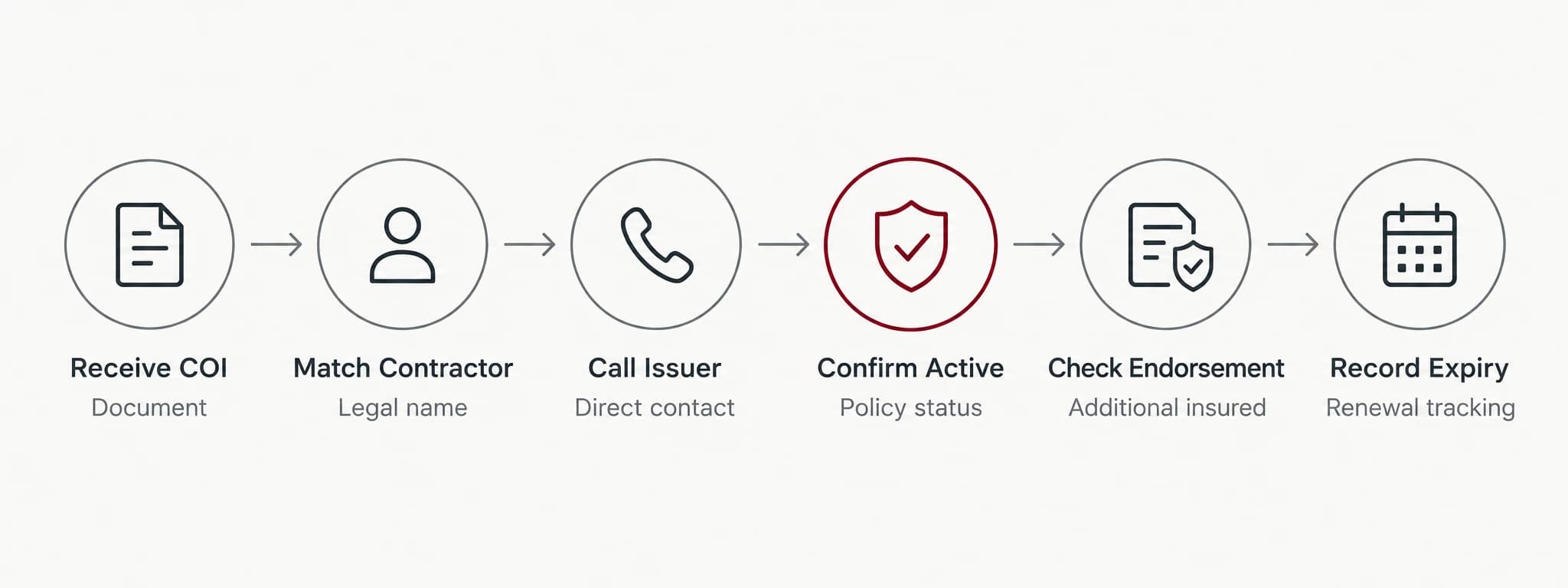
Confirm the certificate with the issuing insurance producer before authorizing the affected work. Verification helps catch a stale document, a mistaken name, or a policy change that a PDF in your inbox cannot reveal.
Ask the contractor to have its agent or broker send the COI and required endorsements directly to the contact named in your request. If you need to follow up, obtain the producer's contact details independently where practical, then ask whether the document was issued by that office and whether a current replacement is available. The producer may need the contractor's authorization to discuss policy details.
Use a short review sequence:
- Match the insured's legal name to the contracting company and identify any subcontractors.
- Compare coverage types, limits, and policy dates with the contract and work schedule.
- Confirm the certificate holder information and collect required endorsements.
- Ask your adviser to resolve unclear exclusions, operations, or wording.
- Save the documents and set a reminder for any policy that expires before the work ends.
Keep the contractor's answers with the certificate and contract. That record gives the next manager or board member a clear account of what was requested and resolved. For a broader vendor review, use the commercial pressure washing buyer's checklist alongside the insurance check.
Request a COI without slowing procurement
Send one precise request that names the project, work, required coverage, and entities to list. A contractor can forward it to its producer, reducing repeated emails caused by an incomplete certificate or an incorrect association name.
A useful request can read:
Please have your insurance producer send a current certificate of insurance for the exterior work described in the attached scope. List the contracting business under its legal name and name the association and management company exactly as shown in the contract. Include the coverage types and limits specified in the insurance exhibit, plus copies of any required additional insured or waiver endorsements. Identify subcontractors proposed for the work and provide their insurance documents. If a requirement cannot be met, tell us before work is scheduled.
Attach the insurance exhibit or relevant contract section rather than asking for a "standard COI." That phrase leaves the producer to infer your requirements. Give the contractor a contact who can resolve a naming or endorsement question, and have one person record the final approved documents.
For ongoing commercial and HOA exterior care, apply the same process to new scopes and replacement vendors. A certificate approved for one set of operations should be reviewed again if the contractor adds a different task or changes who performs it.
Handle a missing or expired policy
Pause the work affected by a missing required document until the issue is resolved under your contract. Request a current certificate or endorsement from the producer, confirm what changed, and document the decision before that work resumes.
An expiration date deserves attention even if the contractor expects an automatic renewal. Ask for the replacement COI and any replacement endorsements when the new policy takes effect. Do not assume the certificate will notify you of cancellation or that an old endorsement necessarily applies to a new policy.
If the contractor cannot provide a required coverage or endorsement, ask your adviser and counsel to assess the gap against the work. They may recommend different coverage, a revised method or scope, or another vendor. Do not quietly lower a contract requirement after the work has started without recording who approved the change and why.
If an incident has already occurred, follow your contract's notice procedures and contact the appropriate insurers or advisers promptly. Preserve the documents and incident details. A later certificate cannot establish that coverage applied at the time of an earlier event.
Frequently asked questions
These answers cover the questions most likely to arise while requesting a contractor COI. Your contract and insurance adviser should settle requirements for the specific property and work.
What is a certificate of insurance for a contractor?
It is a document issued by an insurance producer that summarizes reported policies, coverage types, limits, and policy dates for the named contractor. A property manager uses it to compare insurance information with contract requirements. The certificate is evidence to review, not the insurance policy itself, and it does not grant additional insured rights without the applicable policy terms or endorsement.
Do all contractors need a coi?
A COI is commonly requested when a contractor works for a property owner, association, or commercial customer, but the request depends on the contract and the work. Do not treat the presence of a COI as proof that every contractor has met every legal or project requirement. Set requirements before bidding, then request documents for the contractor and relevant subcontractors.
Can you get a coi as an independent contractor?
An independent contractor who has an applicable insurance policy can generally ask its insurance producer for a COI. The certificate reflects the policy the contractor carries; it does not create coverage. If a person claims an insurance or workers' compensation exemption, request supporting documents and review the claim for the actual work and people coming onto the property.
How do you obtain a certificate of insurance?
Ask the contractor to have its insurance agent or broker issue a current COI directly to your designated contact. Send the exact certificate holder name, project description, coverage requirements, and any endorsement requests in writing. When it arrives, compare it with the contract and confirm unclear or material details with the issuing producer before work begins.
Is a certificate holder the same as an additional insured?
No. A certificate holder receives the document, while additional insured status depends on the policy and applicable endorsement. If your contract requires the association, owner, or management company to be an additional insured, request the endorsement and check the legal name and covered operations. A description typed on the certificate does not replace that review.
What if the contractor's insurance expires during the job?
Ask for a replacement certificate and required endorsements when the new policy takes effect. Track the expiration date in advance so the documents can be reviewed before a gap disrupts the schedule. If required coverage cannot be confirmed, follow the contract's process for pausing the affected work and have your adviser assess the gap.
Sources
The legal references here explain association maintenance responsibility and the stormwater context for exterior work. Project insurance requirements should be set in the contract with advice suited to the property.
If you are planning exterior work, send the scope and insurance requirements together when you request a quote.
Custom Commercial & HOA Walkthroughs
Need a scope tailored to your South Florida property?
Every building, plaza, and community has its own surface mix, access windows, and drainage layout. We quote by walkthrough rather than fixed rate sheets so your proposal matches your exact property. Call us directly at (904) 826-9806 or request a written scope online.
Related services & tools
Commercial & HOA by South Florida city: